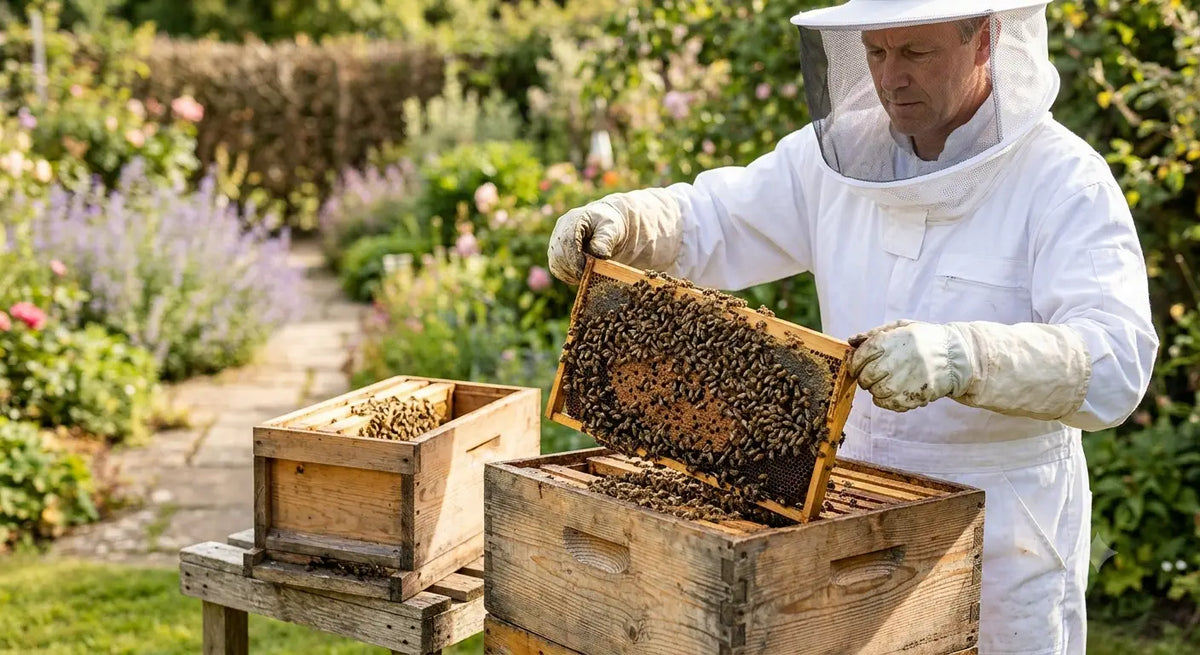
Spending lazy Sunday afternoons in your yard while little yellow workers buzz around you sounds like a dream spring.
And if you share the same dream, you might be wondering where to start from.
Well firstly, rushing to buy a hive and getting everything rolling may sound tempting. But it can be a big mistake.
Beekeeping for beginners should start from learning. Join a local association, take a course and find a mentor. Then get bees in spring or early summer.
Let’s take a step-by-step look at how can you can realistically start beekeeping in UK with no experience.
Key Takeaways
- Before starting, join a local beekeeping association, take a beginners’ course and find a mentor. Hands-on time with experienced beekeepers will teach you more than any book.
- Starting beekeeping for beginners in the UK doesn't require any licence. But registering on BeeBase is highly recommended. It’s the official UK bee health database, and signing up gets you disease alerts and access to bee inspector support.
- Plan the apiary site and equipment before bees arrive. Choose a sheltered, accessible location and prepare the hive and protective equipment in advance.
- Start with a colony from a reputable source. Local suppliers and association members may be able to recommend suitable nucleus colonies, and a mentor can help assess them before purchase.
- Treat the first year as a learning curve. Your first season is about learning to read the colony, and your first winter is about helping it survive.
Learn First: Association, Course and Mentor

It may be tempting to order a nucleus colony and begin immediately. However, starting without adequate training can create avoidable difficulties.
Some new beekeepers realize that the commitment involved is greater than expected. Practical experience before purchasing bees can help clarify whether beekeeping suits them.
The most practical answer to how to start beekeeping in the UK is to join a local beekeeping association. Most of them offer taster days, courses, an apiary for practice and mentorship support.
To find a local association in England, use BBKA’s official site, the Scottish Beekeepers' Association for Scotland and the Ulster Beekeepers' Association for Northern Ireland.
A mentor can be one of the most valuable sources of support for a new beekeeper.
Working alongside an experienced beekeeper provides practical insight into colony management and the realities of beekeeping. Many beekeeping communities are supportive, and association members may be able to help newcomers find suitable guidance.
While learning how to start beekeeping in the UK, you’ll find plenty of information on the internet. But beekeeping is highly specific to your country and local area.
So, as this Scottish adviser warns, avoid unverified sources and learn from local associations or mentors only.
Register on BeeBase

If you are fretting about getting a licence before starting, don’t. That’s because, as the bee centre clarifies, you do not require any license to keep bees in the UK.
Just ask your neighbours if they are alright with little workers buzzing around and you are all set.
But many beekeeping for beginners guide highly encourage you to register your hive with BeeBase. It is the National Bee Unit's free online service and a voluntary registration system.
The National Bee Unit encourages registration to support bee-health surveillance, disease alerts and response to pest and disease risks.
Registered beekeepers may receive alerts about certain notifiable pests and diseases found nearby. Follow any advice provided and contact the National Bee Unit or a local bee inspector where guidance is required.
BeeBase covers England, Scotland and Wales. Beekeepers in Northern Ireland should refer to the Department of Agriculture, Environment and Rural Affairs (DAERA) for local bee-health information and registration arrangements.
Choose a Site and Get Your Kit

The first step in learning ‘how to start a beehive’ is to choose a site for it. It isn’t too complicated of a task. Just keep note of the following:
-
Your hive gets proper sunshine in the morning and some shade in peak sun hours.
-
There’s a clean water source and plenty of forage available nearby.
-
You’ve got easy access to the hive even in wet or muddy conditions without any obstacles on the ground.
-
There should be any sort of windbreaker to protect the hive from stronger gusts of wind.
-
Check if the land you’re setting up on has any tenancy or allotment rules before you commit.
Once you finalise the site, the next step for beekeeping beginners is selecting a kit. A kit is basically all the equipment you would require to handle bees.
Beginners do not need to buy everything at once. A hive, protective clothing, smoker, hive tool and feeder are common starting items, although additional equipment may be required as the colony develops.
The hive must be ready before the bees arrive, because a nucleus should move into a full-size hive within a day or two.
In case you’re planning to use a second-hand kit and swarms as a beekeeping beginner, be extra careful. They can carry disease, so treat them with care and ask your mentor first.
And in clothing, all you need are beekeeping gloves and a bee jacket or a bee suit. They are protective garments that you wear for protection from the bee stings.
If you are confused about whether to buy a jacket or a suit, check out our guide on bee suit vs bee jacket.
Get Your First Bees

The next step of ‘how to start a beehive’ checklist is by buying a nucleus (nuc), the most exciting part of the whole process.
Think of nuc as a mini version of a fully functioning beehive. A typical nucleus colony includes a laying queen, adult bees, brood in different stages and stores. Specifications vary, but a good-quality nuc commonly includes at least three frames containing brood.
Here’s a simple buying check as laid out in detail in the National Bee Unit’s nucleus colony guideline:
-
A young, mated, laying queen.
-
At least three frames of brood in all stages.
-
Healthy-looking brood with no signs of disease.
-
Bees that are good tempered.
-
Frames that fit your hive.
This is an area where association membership and mentor support are particularly valuable. Ask an experienced beekeeper to help inspect the nucleus colony. If you have concerns about its condition, queen status or disease risk, seek further advice before completing the purchase.
One thing to keep in mind is that new colonies need feeding to get going. It’s usually a thin sugar syrup so the colony can draw out new comb.
You might have come across ‘catching swarms’ as an alternative for nucs. But this is a very unpredictable thing. Swarms may not be readily available, and their disease history and queen status are often unknown. Beginners should seek mentor guidance before attempting swarm collection.
Your First Season and First Winter

The most important part of learning how to start beekeeping in the UK is to prepare for your first winter. Winter is when your bees need you the most.
For your first winter, just aim to get the colony through it. Honey comes later. The two main things that you need to do to prepare for winter is:
-
Inspect with Your Mentor: Make sure that your bees are well-fed and clustered together to make it through the winter.
-
Monitor for Varroa: Varroa is a common mite that attacks honey bees. Be on a look out for them.
The National Bee Unit says to monitor for varroa at least four times a year and to use only licensed veterinary medicines. Refer to our winter guide for a more detailed explanation.
As for your first spring or how to treat your bees all around the year, refer to our UK beekeeping calendar.
Conclusion
Beekeeping can be the most challenging yet the most rewarding hobby. But before you start getting to that sweet honey, you need to learn. A lot.
Instead of diving directly into it, begin with reading beekeeping for beginners guides, joining a local association and finding a mentor. They can be a great help and help you from committing common mistakes.
Another thing you need to take into account is that you will get stung. And to protect yourself from that, you need protective gear.
At SaftaBee, we stock high quality beekeeping equipment like gloves, suits and jackets that are also comfortable to work in. Visit our website now to check them out.
Frequently Asked Questions
1. Do I have to register my bees?
BeeBase registration is voluntary, but the National Bee Unit asks beekeepers to do it. It is free.
2. Should I learn how to start a beehive before I buy one?
Yes, this is a must. Join an association and take a course first before buying your first hive.
3. When should I get my first bees?
Usually spring to early summer, when associations and suppliers have nucs. Ask your association for local timing.
4. Where do I get bees?
From a local association or a trusted supplier, checked against the nucleus guidelines.
Share:
Winter Beekeeping: What to Do From October to February
Best Gardening Gloves in the UK: A Guide by Task